Real deployments. Real scope. Every project is different — these are a few that show the range of what we architect and deliver.
Full-facility UniFi deployment for a large commercial operation in Tulsa, Oklahoma. Scope included enterprise wireless coverage, a multi-tiered camera system with AI analysis, structured cabling, fiber interconnects, redundant power, and network-dependent equipment integration across a complex multi-zone floor plan.
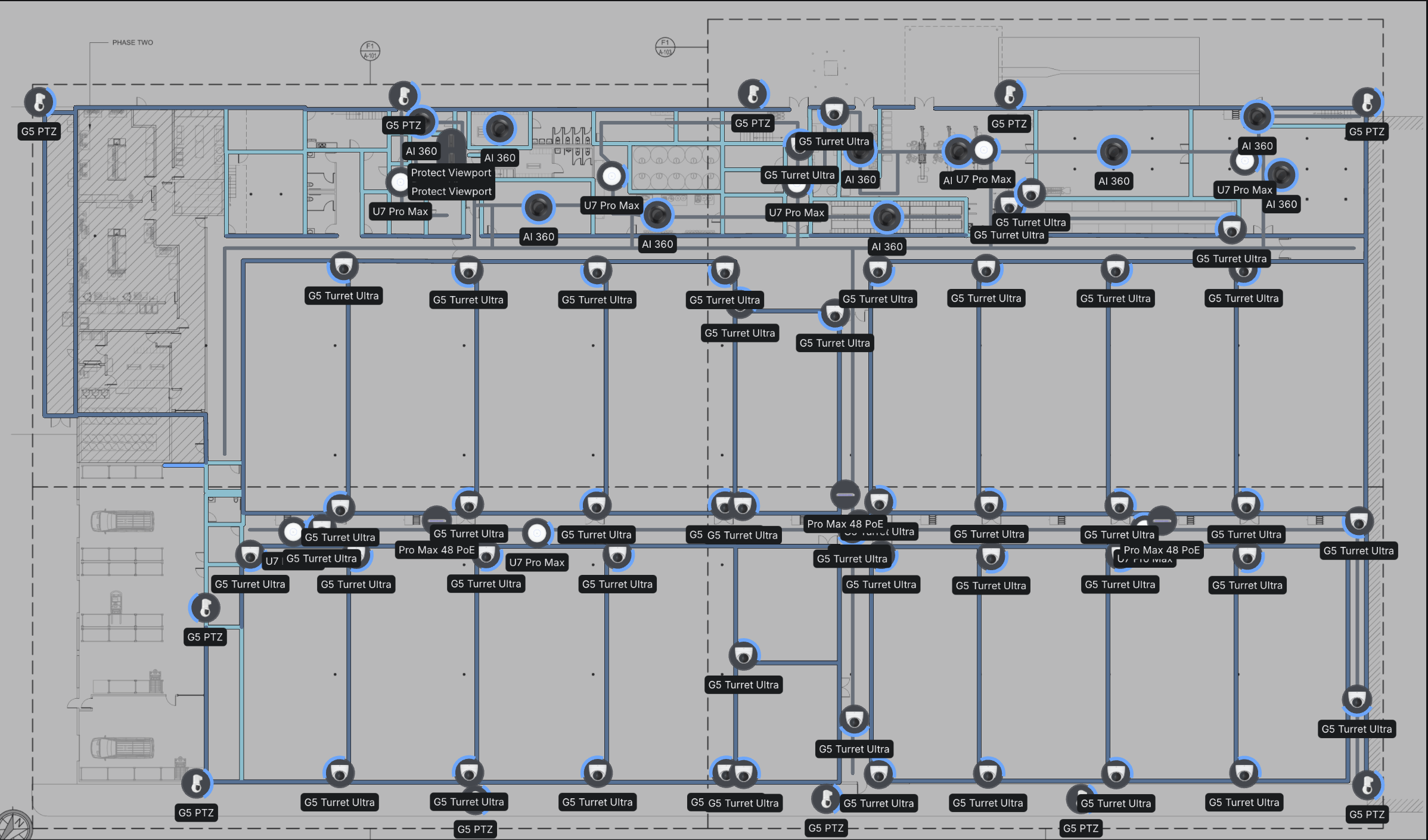
Large-scale commercial facility requiring blanket wireless coverage across a complex multi-zone floor plan — including a mezzanine level — with network-dependent devices throughout: irrigation controllers, access control systems, workstations, and VoIP phones.
Camera system deployed with AI analysis and facial recognition across all zones. Exterior PTZ coverage on perimeter. Fiber interconnects run between MDF and three IDFs to distribute PoE switching capacity across the facility without signal degradation.
Redundant power and smart PDUs provide per-outlet control and power monitoring across the rack stack. NAS provides local storage independent of cloud services.
Architected the full network topology from DMARC to endpoint. Developed complete equipment list and sourced all UniFi hardware. Produced facility floor plan in UniFi Design Center with device placement, coverage modeling, and port mapping.
Scoped and managed structured cabling subcontractor — 135 Cat6 drops, fiber termination and LIU installation across two floors. Supervised installation to ensure compliance with the design spec.
Performed all rack work, switch configuration, VLAN segmentation, AP provisioning, camera configuration, NVR setup, and NAS deployment personally. Final system delivered documented and operational.
Whole-home network overhaul for a 3,000+ sq ft, three-story residence running on a basic ISP combo unit with dead zones throughout. Replaced the entire stack from the demarc out — structured cabling, enterprise-grade UniFi deployment, a custom home server, and deep smart home integration across 100+ devices. The family got a network that behaves like a business, without needing to understand how it works.
The home was running on a basic ISP-provided modem/router combo — dead zones across all three floors, no network segmentation, and zero smart home infrastructure. Starting point was a clean slate.
Over 1,000 feet of Cat6 pulled through three floors — wiring the home office, all TV locations, and strategic drops throughout. Every device that could be wired, was. Wireless left only for devices that require it.
Smart home VLAN configured with split 2.4/5 GHz SSIDs to ensure compatibility across 100+ IoT devices — many of which are 2.4 GHz only. A dedicated kids network with NextDNS filtering and DoH/DoT blocking keeps DNS queries from bypassing content controls at the protocol level.
Custom home server hosts Plex, Homebridge (bridging non-HomeKit devices into Apple Home), and supporting services — all running locally, off cloud subscriptions.
Designed full network topology and VLAN architecture. Pulled and terminated all Cat6 runs — home office, media locations, and utility drops across all three floors. No subcontractors; all cabling performed directly.
Rack built and configured from scratch: Dream Machine, aggregation switch, 48-port PoE, NAS, UPS, and Smart PDU. All switching, firewall rules, VLAN segmentation, and wireless configuration performed and documented.
Sourced, installed, and integrated all smart home devices. Homebridge configured to expose non-native HomeKit devices into a single unified Apple Home environment. Sonos zones aligned with room layout. Moen Flo and sump monitor providing real-time water monitoring with alerting configured.
System handed off with documentation and a walkthrough — the family can manage day-to-day without needing to understand the infrastructure beneath it.
Designed and built a complete loan origination system from the ground up for a non-QM private lending operation — covering intake, CRM, underwriting, doc generation, and closing. Architected a relational data model across 25+ custom applications, connected 8 external APIs, and implemented hundreds of workflow automations to handle data validation, credit scoring, document generation, and payment processing. The platform processed over 10,000 applications across three years in production.
New deployment for a non-QM private lending operation with no prior origination infrastructure — the process was built from scratch by shadowing operations and translating manual workflows into a structured, automated platform. The data model separated contacts, clients, and properties as independent relational objects, enabling a single client to span multiple deals and properties without duplication or record fragmentation.
Underwriting was supported by a structured validation checklist mapping every required data point, check, and external resource — flood cert, credit, property data — into a repeatable review process. Credit scoring automation retrieved soft pull data across multiple bureaus, detected outliers, averaged the scores, and automatically matched each deal to its product tier based on configured thresholds.
Doc generation covered the full origination lifecycle: initial engagement letter, pre-approval, loan terms packet, appraisal template, site visit template, loan application, final approval, loan docs, and a formatted data export for import into the servicing platform. RightSignature delivered the pre-approval packet, collected credit authorization, and triggered payment via embedded Stripe — with transaction data carrying back to the platform's AR log automatically.
Hundreds of automations handled data quality and process logic throughout — including enforcement like forced lowercase normalization on email fields to prevent database corruption. Every rule was hand-coded using PHP functions within the automation engine; none of this was handled natively by the platform at the time.
Sole designer, architect, and developer. Gathered requirements directly from the client and shadowed operations to understand the lending workflow at a process level before any build began. Translated that into a relational data model, built every application and automation, and connected all external APIs.
Developed iteratively alongside client staff — using their real-world usage patterns to surface edge cases and refine the system through each release cycle. Post-launch, extended the platform to cover servicing activities: loan extension requests, repair draw requests, and loan payoff processing.
A 15,000 sq ft meat processing facility — existing operation with zero network infrastructure, and a new construction shell under build-out that would 1.5x the footprint before interior walls existed. Insurance required continuous camera coverage throughout; state compliance required temperature monitoring across all refrigeration zones. Designed the full network from scratch, planned cabling pathways through an active construction environment, and stood up the facility's entire operations software stack — client intake, animal tracking, slaughter management, payment processing, inventory, and ecommerce — none of which existed before the project began.
The facility had no existing network, cabling, or technology infrastructure — every run, every rack position, and every device placement had to be planned from scratch. The added complexity was the construction state: the new shell was a finished exterior with an open interior, no walls, no conduit runs, and no finalized floor plan for where equipment would eventually land. Placement decisions had to be made early enough to stub out correct locations while leaving flexibility for the eventual build-out.
The environment added constraints on every decision — wet floors, cold zones, condensation, large equipment vibration, and camera placement in non-standard locations to maintain sightlines through the processing areas. Insurance required continuous recording coverage with no blind spots. Compliance required temperature monitoring and logging across all refrigeration zones.
Beyond the network, identified and implemented the facility's entire operations platform from scratch: client scheduling and intake, animal tracking from arrival through processing, slaughter workflow with chain of custody, inventory and cut tracking, payment collection, and a direct-to-consumer ecommerce channel. None of this existed before the project started.
Designed the full network topology and cabling plan — both for the live operational space and with stub-out provisions mapped for the construction shell's future interior. Produced device placement and coverage plans accounting for the industrial environment: moisture, cold, and non-standard mounting positions required by the processing floor layout.
Procured all equipment. Scoped and contracted the structured cabling subcontractor for jack-to-jack runs. Supervised the cabling installation, performed all rack build and configuration, and handled every last-mile device connection directly.
Separately identified, selected, and stood up the full operations software stack — translating the facility's workflows into a configured platform covering the entire lifecycle from customer intake through final sale.
A private equity firm managing properties, notes, and investors across 32 corporate entities had assembled a fragmented stack of best-of-breed software — each doing its job, none of them talking to each other. Month-end close was landing around the 15th. Identified the Yardi enterprise suite as the only platform capable of unifying all four layers of the business under one GL, then PM'd the full migration: Voyager, Debt Manager, Investment Accounting, and Investment Manager — four sequential workstreams executed in conjunction with Yardi's implementation team.
The company operated as a fully integrated private equity platform — acquiring and managing residential and commercial properties, originating and servicing private mortgage notes, and reporting performance to investors through distribution structures. That business ran across four separate software stacks with no shared data model, requiring manual data handoffs, duplicate entry, and a full-time reconciliation burden just to close the books each month.
The core insight was architectural: Yardi's enterprise suite could model every layer of the business — assets, debt, investors — with a single chart of accounts and a unified GL. The work began with re-architecting the master COA: 32 QuickBooks instances running on different GL trees, some inconsistently structured even across similar entity types, all converged into one clean chart before migration could begin.
Four sequential implementation workstreams followed, each coordinated with Yardi's PMs: Yardi Breeze to Voyager for property management, The Mortgage Office to Debt Manager for note and loan servicing, InvestNext to Investment Manager for investor and distribution management, and finally all 32 QuickBooks Desktop instances to Yardi Investment Accounting. Each phase required data mapping, validation, parallel testing, and cutover coordination before the next could begin.
Identified the Yardi suite as the right fit after evaluating the full scope of the business — a rare case where a single vendor's product line handles property management, loan servicing, investor relations, and entity accounting under one roof. Led all project management alongside Yardi's implementation team: discovery, COA re-architecture, data mapping, migration sequencing, and go-live coordination across all four workstreams.
The result was a unified platform where a dollar collected on a property or a note payment received could flow through the GL, be allocated across the correct entity, and be reported to the investor level — without a single manual handoff between systems.
A mid-size company (26–100 employees) operating under SynchronyHR as their PEO, running HR through PrismHR. Leaving a PEO is not just a software swap — it means the organization takes direct ownership of payroll, benefits administration, compliance, and HR operations that the PEO previously managed. Executed the full migration end-to-end: employee records, payroll configuration, benefits carrier setup, and onboarding workflow build-out in BambooHR, with a clean cutover off SynchronyHR/PrismHR.
Operating through a PEO means the PEO is the employer of record — handling payroll tax filings, benefits carrier relationships, workers' comp, and HR compliance. Exiting one requires the client to stand up all of that infrastructure independently before the cutover date. The migration wasn't just data transfer; it was building out a fully operational HR function from scratch in a new system with a hard deadline.
PrismHR, the platform SynchronyHR operated, is an enterprise PEO backend — not designed for direct client access or simple data exports. Extracting clean employee data, payroll history, and benefits enrollment records required careful handling to produce a BambooHR-compatible import without data loss or misalignment during the cutover window.
BambooHR was configured across all four domains: HR records and org structure, direct payroll with proper tax setup, benefits administration with carrier feeds, and onboarding workflows including e-signature documents, task automations, and new hire sequences. The system had to be operationally ready before the PEO relationship terminated.
Managed the entire migration — scoping the timeline around the PEO exit date, extracting and cleaning data from PrismHR, and configuring BambooHR across all domains. Handled all payroll setup, benefits carrier connections, and enrollment configuration so the client could run their first independent payroll without delays.
Built out the full onboarding experience in BambooHR — templates, automated task sequences, e-signature documents, and role-based workflows — so the system was not just migrated but meaningfully improved over what the PEO was providing.